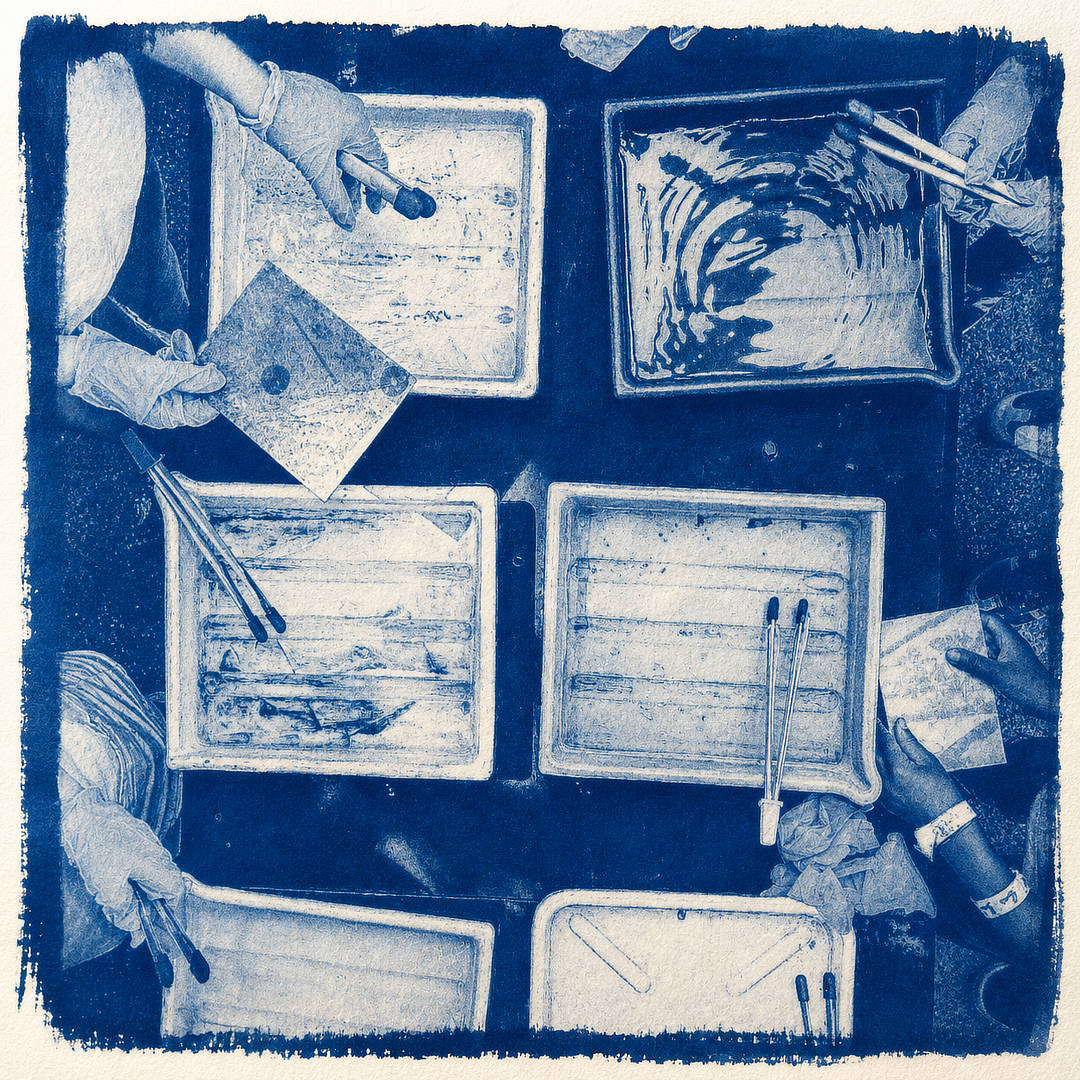
Mix your own cyanotype chemistry, make a collection of finished fine-art prints, and learn how to push the process far beyond basic blue.
-
Materials Included: Raw cyanotype chemistry, fine-art watercolour paper, toning materials, and finishing supplies.
-
Hands-On Equipment: Work with UV exposure units, coating brushes, drying racks, paper cutters, and print-flattening equipment.
-
Make: Coat and expose multiple cyanotype prints using botanicals, objects, stencils, or digital negatives.
-
Leave With: A collection of finished cyanotype prints and a repeatable workflow you can use again.
Discover the tactile magic of cyanotype and take it well beyond basic blue prints. In this intensive six-hour masterclass, students learn how to mix raw chemical solutions from scratch, coat fine art papers, arrange compositions, and expose prints using sunlight or UV units.
In the afternoon, students dive into experimental toning using botanical tea baths, coffee, and soda ash to transform classic Prussian blues into rich sepias, deep aubergines, and charcoal blacks. Each participant leaves with a collection of portfolio-ready prints and a deeper understanding of alternative printing processes.
About Your Instructor
Melody Maloney is a commercial photographer and educator who knows how to keep things sharp, well exposed and occasionally a little retro. Her work spans interiors, portraiture and events, fuelled by good music and a love of all things vintage.
Learn more about Melody
Workshop Rundown
Morning Session: Chemistry, Composition & Coating
-
10:00–10:45 am | Guided Chemical Mixing & Safety: Welcome, studio orientation, and historical overview of cyanotype. Guided group exercise weighing and mixing Part A (Ferric Ammonium Citrate) and Part B (Potassium Ferricyanide) from raw powders under instructor supervision. Safety protocols, light handling, and paper selection guidelines.
-
10:45–11:30 am | Composition & Negative Preparation: Arranging botanical specimens, lace, stencils, and three-dimensional objects. Integrating student-provided pre-printed negatives and pre-ordered UAC add-on transparencies. Principles of contrast, exposure density, and visual balance.
-
11:30 am–12:30 pm | Paper Coating & Darkroom Prep: Demonstrating coating techniques using foam and hake brushes on various watercolour stocks. Students coat 4–6 fine art paper sheets and place them in the dark drying area with fan support.
- 12:30–1:15 pm | Lunch Break
Afternoon Session: Exposure, Toning & Experiments
-
1:15–1:45 pm | Exposure Test Strips & Calibration: Conducting step-wedge exposure tests to determine ideal exposure times. Calibrating exposures for both artificial UV units and ambient sunlight.
-
1:45–2:30 pm | Main Exposure, Washing & Oxidation: Exposing final prints and executing proper water-rinsing cycles. Using a dilute hydrogen peroxide bath for instant oxidation and maximum colour depth.
-
2:30–3:30 pm | Toning & Wet-on-Wet Techniques: Bleaching and toning using sodium carbonate baths followed by green tea, black tea, coffee, or tannic acid to alter print hues. Applying vinegar, turmeric, salt, or soap bubbles directly to wet coated paper for organic textures.
-
3:30–4:00 pm | Print Flattening, Critique & Wrap-Up: Drying and flattening prints using blotters and presses. Group feedback session, care instructions, and pack-up in rigid mailers.
By The End Of This Workshop, You Will:
- Understand the basic chemistry and safety practices behind the cyanotype process.
- Mix cyanotype solutions from raw materials and prepare fine art paper for printing.
- Build compositions using objects, stencils, botanicals, and digital negatives.
- Test and calibrate exposures using both sunlight and UV exposure units.
- Wash, oxidize, and finish cyanotype prints for strong colour and detail.
- Experiment with botanical toning, bleaching, and wet-on-wet techniques to create a wider range of colours and textures.
- Leave with a collection of finished cyanotype prints and a repeatable alternative-printing workflow.
What We Provide
-
Cyanotype Chemistry: Ferric Ammonium Citrate, Potassium Ferricyanide, scales, mixing containers, tray baths, and hydrogen peroxide.
-
Toning & Experimental Materials: Soda ash, green tea, black tea, coffee grounds, tannic acid, and materials used for wet-on-wet experiments.
-
Paper & Coating Supplies: Fine art watercolour paper, hake brushes, and foam brushes.
-
Exposure & Finishing Equipment: UV exposure units, paper cutters, drying racks, blotters, presses, and rigid mailers for transporting finished prints.
What To Bring & Requirements
-
Objects & Negatives: Botanical items, lace, stencils, flat or three-dimensional objects, or pre-printed digital negatives you would like to work with.
-
Apparel: An apron or work shirt you do not mind getting stained.
-
Optional UAC Pre-Printing Add-On: Transparency printing is available at checkout for $10–$15 per file. Image files must be submitted at least 48 hours before the workshop.
Event Details
-
Location: Urban Art Collective Art Hub, 50 Bayswater Avenue, Ottawa
-
Instructor: Melody Maloney
-
Level: Beginner to Intermediate
-
Maximum Capacity: 12 students
-
Minimum Enrolment: 6 students required